
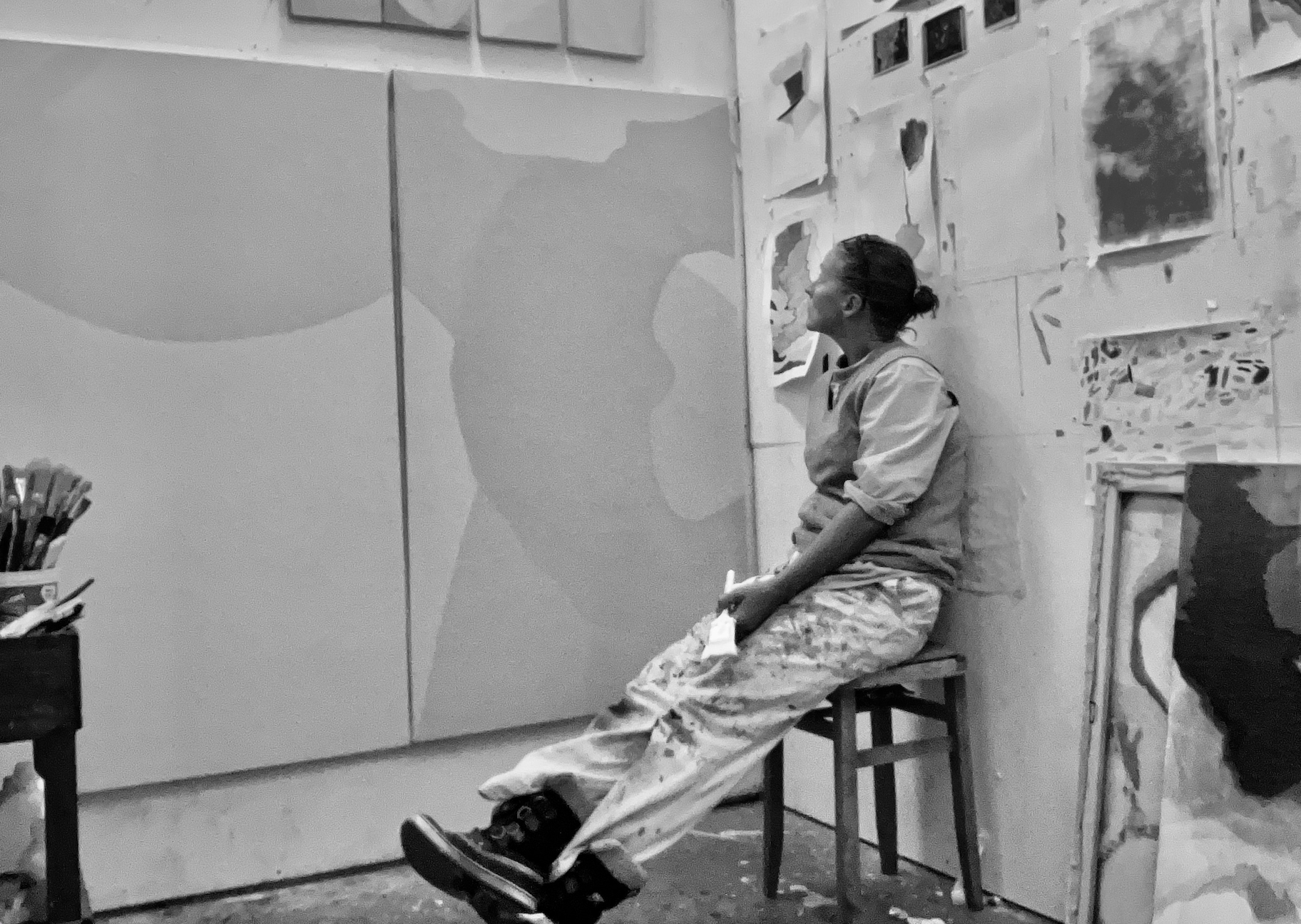
Artist Statement
Matilda Wainwright's paintings emerge from memory — specifically memory of colour: an atmosphere, a quality of light, sensation held in the body long after a moment has passed. Drawn from the language of abstraction with its capacity to be at once open and precise, is her understanding of paintings tran-subjectivity, the capacity of paintings meaning to move across and between individual experience. Paint operating not as a vehicle for meaning but a co-producer: matter and meaning co- activated in the act of making, each shaping the other. Wainwright believes that the radical openness of what a painting might become during its making is essential to the essence of painting itself.
Drawn to mythology since childhood, Wainwright finds in the idea of deep time both solace and purpose. We float, she believes, within a vast network of time and space — halfway through the life of this planet and it is painting's particular capacity to contain past, present and future simultaneously. A canvas both vessel and portal: for memory, for sensation, for the accumulation of looking. The cave paintings at Lascaux feel as urgent to her as anything made today; she shares the endeavour of those torchlit artists hand pressing pigment to surface. The luminous gold of Cavallini and Giotto — their angels' wings manifesting both eternal and other within the two-dimensional — speaks to the same impulse she pursues in paint.
Her process oscillates between instinct and decision, surrender and control. Chaos becomes order then collapses only to rebuild, this rhythm, until resolution. Absence and presence are held in equal weight. Layers accumulate — colour, form, rhythm — as complexity emerges within simplicity, echoing the strata of matter, space and time. The surface becomes at once cosmic and nanoscopic, now and always. Each painting gives off what she calls a low hum of exuberance — the quiet charge of deep attention made visible.
Wainwright lives in rural Cheshire and maintains a studio at OA Studios in Salford, Manchester. She moves between these two worlds — foraging for colour in landscape, drawing and painting en plein air — then carries these charged memories back to the urban studio, where they are transformed. Her paintings do not depict places; they are distillations of how colour felt, how light behaved, how a moment of sky or water settled into the body. How many blues exist in a drop of water, or the sea? Colour, for Wainwright, is not a property but a condition — mercurial, infinite, irreducible.
Matilda Wainwright